After the Tribute

I am sharing these words just a few days after the tribute to Gazan poet Heba Al-Madhoun. Because of the tribute, I am still seeing Heba’s surviving children listening to their mother’s verses at a bilingual reading taking place in a repurposed steam engine factory, in Cambridge, Massachusetts. I am still hearing how they responded when I asked them, afterwards, what it was like to hear their mother’s poems in English. I will not write what they said. It is too soon after the tribute.
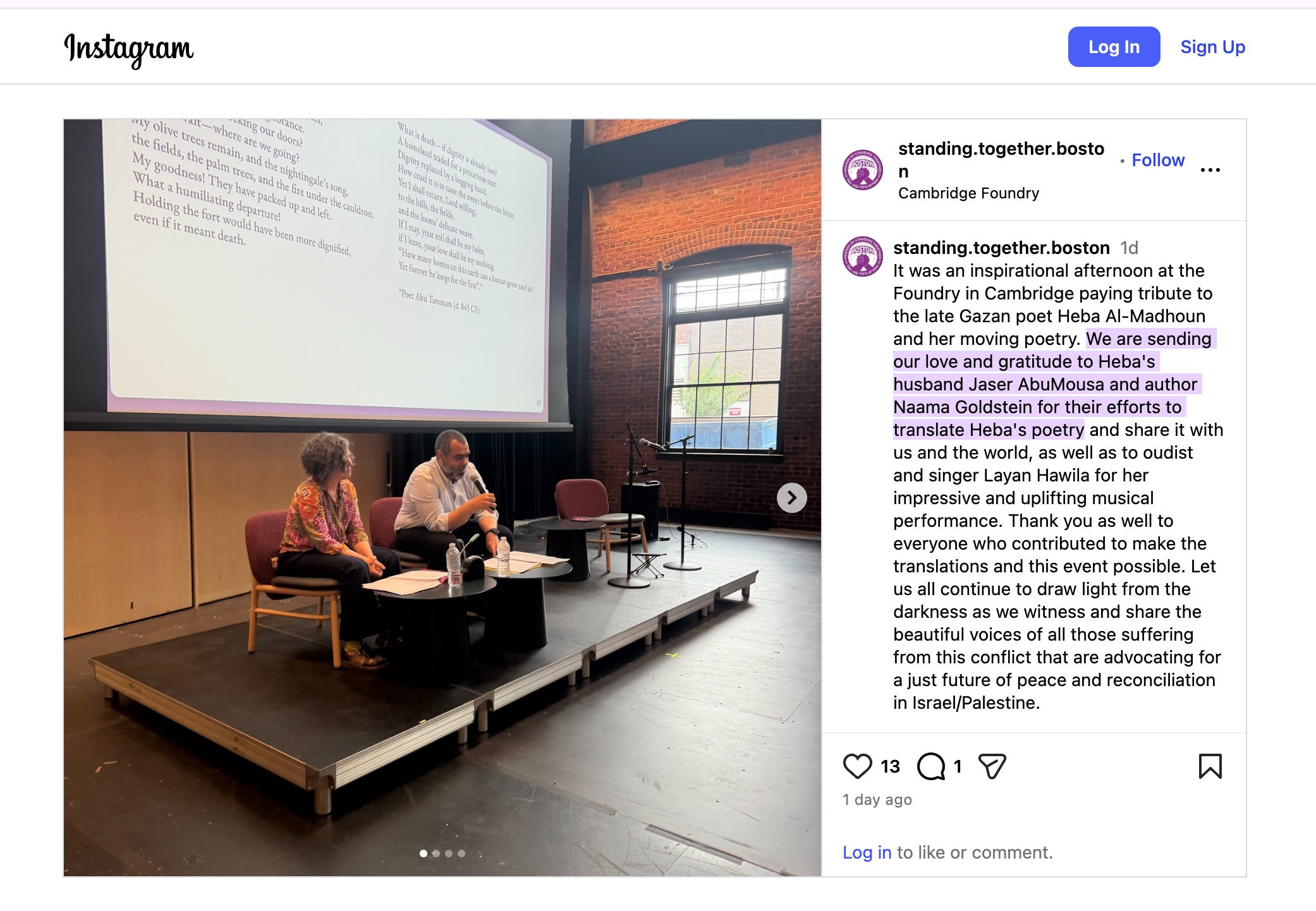
Some months before the recent tribute, early this autumn, the solemn father of these children has not yet walked into our home on a Sunday, gifting us a tray of baklava before he lunches with us. I do not know this is the season when I will enlist to bring to English translation the poems outliving their author, a woman about twelve years younger than I who will not reach my age. I have not yet spoken with the grieving husband of a Gazan poet killed in the first month of a versatile genocide still in progress now.
When I write what I’ll decide to excerpt after the tribute to Heba, I am working on a book of nonfiction entitled Mixed City, which concerns itself with hospitality in a time of social collapse. I am documenting, at that phase, the experience of hosting local friends during a genocidal chapter unfolding elsewhere.
Involving us all. Three of us at that dinner table are citizens of Israel, they Palestinian, I Jewish, and the fourth character is a lifelong New Englander.
From Mixed City
We were something like stupefied once they drove off after dinner, having accepted the bag of fresh haddock from our son’s latest saltwater haul.
On the one hand, what a relief. A sacrilege has been averted. Some rites may not be omitted. Some ethics are obligatory and the words articulating them are sacred. What must be said must be said at the compelling time.
I produced the relevant statement, I can’t remember the words. I called the present assault what it is, that I know, and my husband concurred. A lifelong New Englander considers himself implicated, too.
Twenty-one kinfolk cut down in the first week of the genocide, when does she tell us this, not right away.
Definitely this happens after we catch up over wine in the living room. We have transitioned to the bigger table when we acknowledge what we must. We have partaken of dinner. Evening has made way to night.
Initially they share the witnessing task. Then he falls mute while she perseveres. Each of the twenty-one relatives was his.
#
It is in an earlier movement of our dinner conversation that the subject of shattered hope comes up. This is when my dinner guests recall their response to an Israeli prime minister’s assassination. They cried for him. Each of them says this. We cried.
I say the same, in the singular. I cried. My husband was not dialed into the relevant geopolitics then. He is sad at present.
None of us idolize the would-be peacemaker, knowing his militarist record. The Israeli citizens among us will recall the corresponding rhetoric. We might rehear his distinctive voice. My dinner guests and I grew up under his Prime Ministership.
My conception of him reflected my circumstances and age. I thought him a much handsomer oldster than his leading opponent but a weird rhetorician, a droner.
His was the influential party that would never gain my parents’ vote, representing the agenda of the majority for whom socialism outranked religion. Religiously, my parents backed a party winning fewer seats, advancing the priorities of our societal niche, the religious nationalists.
What my dinner guests thought of this prime minister while they were maturing, I can guess. Another leader of the standard mold, an aging warrior, another man with the blood of their people on his hands.
And the dust of their ruins on his soles. Nevertheless it is possible they voted for him in adulthood. Certainly they believed in his change of heart. They believed we were advancing into a constructive chapter.
Next the evolving leader is gunned down.
#
A dinner guest of my generation who originates on my formative soil recalls to us his younger self. We did not know each other then.
At my table, he is the fellow empty nester who will duck under serener moments of our conversation to explore the qualities of whatever pickles are near him. As a young Palestinian citizen of Israel he sought out the coexistence movements of an encouraging era.
I didn’t. I was navigating my first decade of adulthood on an unfamiliar soil, the North American Midwest. I was seeking rapid and intense connections in the livelier corners of an inhibited city. I was bonding with young men inclined to undermine an intimate.
I missed the charismatic throngs peopling a corridor of smoggy cities across which I adventured toward womanhood on buses conveying me coastward and homeward.
I missed discolored stucco cladding, multilevel porches staffed with omnipresent busybodies, and flat tarred rooftops tangled with antennae, cluttered with water tanks and solar panels. I longed for an industrial city of the Israeli interior while remembering its distinctive miseries and terrors.
It was not my choice to emigrate. I was a minor at the time. My family’s relocation wasn’t defined as permanent.
I think that some of us knew that it was. I did. And I intuited the impetus that was never spelled out, relating to the damage done to a family member by what some pundits were calling our first war of choice.
As a Boston hostess of advanced middle age, I will face another child of Israel’s central urban district while his weathered face communicates pity for the young man he was, an individual who thought that he might thrive where he was born.
Evidently I would like to invite his optimism back. That must be why I mention to him the contemporary movement trying to rally a transformative horde. The purple shirt people, yes, he has heard of them.
And isn’t compelled, to judge by his tone and demeanor.
His wife hasn’t heard of them and is guardedly curious. A quick profile for her benefit.
#
In this monstrous chapter, Palestinian and Jewish citizens of Israel labor together to rebuild their living system as an actual democracy invested in every citizen and the whole region’s wellbeing.
I won’t hype the purple shirt agenda beyond this. I am disinclined to propagandize.
It does occur to me that I ought to demonstrate more hope. After all, hope is a defining attribute of mine. It is an instinct I can’t do without.
An inward experience, like a pilot light sustaining its glow in a dark oven, this useful flame requires fuel, which can run out. While fuel is plentiful, a damaged mechanism will produce an unreliable flame and toxic fumes.
#
My experience of hope does not translate into a propagandist urge, and the gazes connecting over dinner do not convey hope.
We all know what the sensible mindsets and compassionate souls inhering on our onetime home soil are up against. A colossal circus of lurid acts, diverse performances of peak fury and alarm and suffering.
Or the stoniest coldness and rigidity.
Another very risky emergency mode, a profound vacuity. An emptied character will keep you busy. This degree of automation can be seen as a disciplined practice, a transcendent faith, a superhuman confidence, a vengeful zeal.
How methodically we disconnect from ourselves. How fastidiously we demolish our humanity.
#
Possibly my dinner guests cannot believe that the purple shirt agenda is viable. Maybe they’re right. Conceivably, Palestinians and Jewish citizens of Israel are natural companions only in exile. Only once we are surviving and struggling or thriving elsewhere do we find in one another characters with whom we feel especially at home. Why, it is just as if we came into ourselves in the very same setting.
I think that the exilic figures sharing this experience ought to report on our finding to the people who persist in the increasingly violent home. We ought to share what we have learned with those still inflicting or enduring horrific abuses. Maybe they’ll take an interest in this survey: Four out of four people at one Boston table know that we are capable of a nurturant bond.
And a meshing perspective. Our dinner guests are people we have known since young parenthood. Shared scenes lodge in our memories, shared meals, shared spaces.
Shared learnings concerning the legends of authoritarian ancients. Systems governed by suppressive advantage. Patriarchy, for example. The more muscular anatomy runs the show.
The most volcanic temperaments determine our fates with myopic aggression, wedding us to their most overactive reflex, dominance.
One category of humanity inhibits the other. My chronicle excludes you. Some of us are legendary, some tangential.
Some expendable.
#
We have seen how the harmonious propensity of ordinary people is undermined continually by grabby opportunists and ravening mystics. Their motivations vary, and their tactics.
Some maneuvers are analogous. The destination is always the same. Though they might tell themselves another story, they promote themselves by destroying others. They really care only about what they see in the mirror.
As a species we prove too susceptible to insular tyrants. We ought to research and perpetuate the rarer condition, enduring resistance.
~~~~